

Choosing between a ducted heat pump vs ductless mini-split isn’t always straightforward – and the right answer looks different depending on the home you’re starting with. Both systems deliver efficient heating and cooling, but they suit different situations, and picking the wrong one for your setup can mean unnecessary cost and compromised comfort.
If you’re weighing up your options in Duncan, Ladysmith, Lake Cowichan, or anywhere across Vancouver Island, this guide will help you figure out which direction makes more sense. And when you’re ready to talk specifics, our heat pump services team is here to help.
The Core Difference Between the Two Systems
Before getting into which suits your home better, it helps to be clear on what sets these two systems apart.
A ducted heat pump works through a central air handler connected to a network of ducts running through your home. Conditioned air is distributed through vents in each room – the same infrastructure a gas furnace uses, just powered by a heat pump instead.
A ductless mini-split skips the ductwork entirely. One outdoor unit connects to one or more wall-mounted indoor units, each conditioning the space it’s installed in directly. No ducts, no central air handler, no shared airflow between rooms.
That fundamental difference – ducts or no ducts – is what shapes almost everything else about how the two systems compare.

Start With What Your Home Already Has
The most practical place to start is your home’s existing setup, because that has the biggest influence on which system is the better fit.
If your home has existing ductwork in good condition, a ducted heat pump is a natural upgrade path. The infrastructure is already there, and swapping in a heat pump means whole-home heating and cooling from a single central unit. If you’re replacing an aging gas furnace with existing ducts, this transition is often the most cost-effective route.
If your home has no ductwork – common in older homes built before central heating became standard, and in many homes across the Cowichan Valley – a ductless mini-split avoids the significant expense of installing ducts from scratch. In these situations, a ductless system is almost always the more practical and cost-effective choice.
If you have partial ductwork – covering some areas of the home but not others – a combination approach can work well. A ducted system handles the main living areas, while one or two ductless units cover spaces that don’t connect to the central ductwork.
Thinking About Your Home Room by Room
Beyond ductwork, the layout of your home and how you actually use it day to day matters.
Ductless mini-splits offer room-by-room temperature control that ducted systems can’t match without significant add-ons. Each indoor unit operates independently, which means the bedroom can be cooler while the living area stays warmer – or you can stop conditioning rooms you’re not using. For households where different family members have different comfort preferences, or where certain rooms go unused for stretches of time, this flexibility has real practical value.
Ducted systems, on the other hand, treat the home as a single zone by default. They’re well suited to open-plan homes or households that prefer one consistent temperature throughout. Adding zoning to a ducted system is possible but involves additional equipment and cost.
Our ductless systems page has more detail on the range of mini-split configurations available for different home layouts.
Installation: What to Expect for Each
Installation complexity and cost differ significantly between the two systems depending on your starting point.
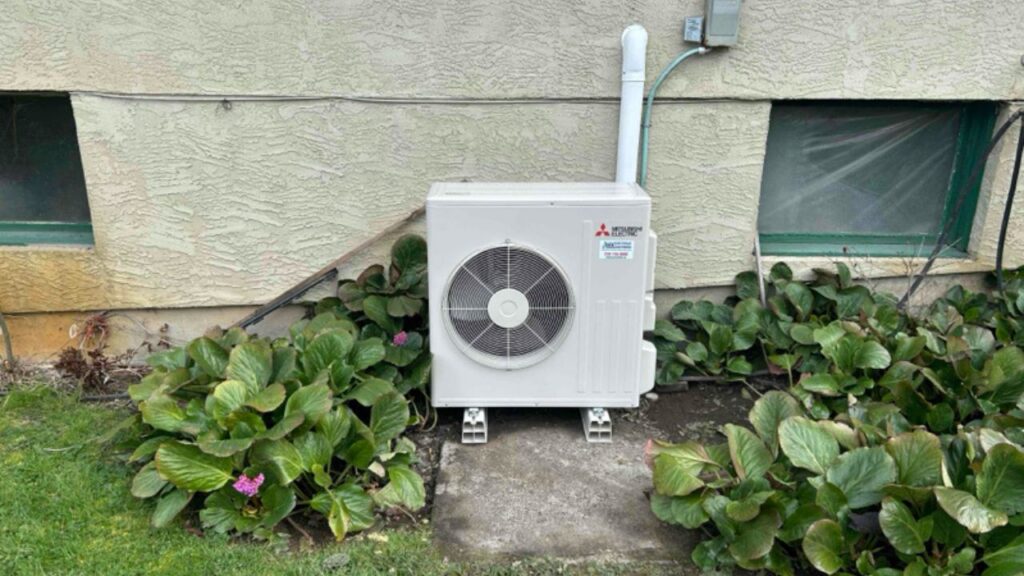
For a ductless mini-split, installation is relatively contained – the outdoor unit goes on an exterior wall or pad, refrigerant lines run through a small hole to each indoor unit, and electrical connections are made. In most cases, a standard single-zone installation can be completed in a day with minimal disruption to your home.
For a ducted heat pump, the picture varies. If your home already has ducts, installation is straightforward – the new system connects to existing infrastructure. If ducts need to be added or significantly modified, that work adds time, cost, and disruption, particularly in finished homes where walls and ceilings need to be opened up.
Getting the right installation from the start matters as much as choosing the right system. A heat pump that’s improperly sized or installed will underperform regardless of which type it is.
Efficiency on Vancouver Island
One question homeowners on the Island often ask is how both systems hold up through the cooler months. The good news is that modern cold-climate heat pumps – both ducted and ductless – are designed to operate efficiently well below freezing, which is well outside what the Cowichan Valley typically sees.
Ductless systems have a slight efficiency edge in homes without existing ductwork, since ducts can lose heat to unconditioned spaces like attics or crawlspaces. According to Natural Resources Canada, heat pumps deliver two to three units of heat for every unit of electricity consumed – an efficiency ratio that applies to both system types.
In a well-sealed home with good ductwork, the efficiency difference between ducted and ductless narrows considerably.
Aesthetic and Practical Considerations
This one comes down to personal preference, but it’s worth thinking through.
Ductless indoor units are wall-mounted and visible in the rooms they serve. Most homeowners find they stop noticing them quickly, and modern units are slim and relatively unobtrusive – but they are there. Ducted systems keep everything out of sight, with only ceiling or floor vents visible in each room.
On the practical side, each ductless indoor unit needs to be cleaned and maintained individually, while a ducted system has one central filter to manage. For multi-zone ductless setups with several indoor units, this is worth factoring into your ongoing maintenance planning. Our HVAC maintenance team can take care of both system types across the Cowichan Valley.
Which One Is Right for Your Home?
There’s no universal answer to the ducted heat pump vs ductless mini-split question – but there is usually a clearly better fit once you look at the specifics of your home.
A ductless mini-split is likely the better fit if:
- Your home has no existing ductwork
- You want independent temperature control room by room
- You’re conditioning a specific area like a basement suite, addition, or detached workshop
- You want a faster, less disruptive installation
A ducted heat pump is likely the better fit if:
- Your home already has ductwork in good condition
- You prefer whole-home comfort from a single centralized system
- You’re replacing an existing furnace and want a seamless transition
- You prefer a cleaner look with no wall-mounted units in living spaces
Still unsure? That’s what we’re here for. A site visit lets us look at your home’s layout, existing infrastructure, and usage patterns and give you a clear recommendation rather than a general one.
At Westisle Heating & Cooling, we’ve been helping homeowners across the Cowichan Valley find the right heating and cooling setup since 1989 – and we’re happy to walk you through the decision honestly.
Get in touch with our team today and we’ll help you figure out the best fit for your home.
Frequently Asked Questions
What is the main difference between a ducted heat pump and a ductless mini-split?
A ducted heat pump distributes conditioned air through a network of ducts connected to a central air handler, heating or cooling the whole home from one unit. A ductless mini-split uses individual wall-mounted units in each room, with no ductwork required. The right choice depends largely on whether your home has existing ductwork.
Is a ductless mini-split more efficient than a ducted heat pump?
In homes without existing ductwork, ductless systems often have an efficiency advantage because there are no ducts to lose heat through. In homes with well-sealed, properly maintained ductwork, the difference is less significant. Both system types are substantially more efficient than conventional electric heating.
Can I use a ductless mini-split as my only source of heat?
Yes. In most Vancouver Island homes, a properly sized ductless mini-split can serve as the primary heating and cooling system year-round. Modern cold-climate units perform reliably through the region’s winters without needing any backup heating system.
What happens if I want to heat a room that isn’t connected to my ducted system?
A ductless unit installed in that specific room is a common and practical solution. Many homeowners run a ducted system for the main areas of the home and use one or two ductless units for spaces that don’t connect to the central ductwork.
How long does installation take for each system type?
A single-zone ductless installation is typically completed in one day. A ducted heat pump installation on a home with existing ductwork is also usually a one-day job. More complex installations – multi-zone ductless setups or ducted systems requiring new ductwork – will take longer. Your technician will give you a clear timeline before work begins.
Do both systems qualify for BC rebates?
Yes. Both ducted and ductless heat pump installations can qualify for rebates through CleanBC and BC Hydro programs, depending on eligibility. Installing with a certified contractor is required to access these programs.